

There are many things I imagined I would be doing when I grew up. Running a safari lodge, raising three children in the middle of the African bush and spending a considerable amount of my time worrying about the welfare of buffalo was not necessarily one of them.
But here we are.
Anton and I have spent the better part of our married lives living on the edge of Nairobi National Park, raising William, Netty and Alex, and sharing our home with an extraordinary collection of wild neighbours. Some are charming, some are downright antisocial, and a few have caused us considerably more trouble than the children ever have. Which, given that we’ve raised three of them, is saying something.
People often ask us what animals they can expect to see in Nairobi National Park. It’s a perfectly reasonable question, particularly when you consider that we’re sitting on the edge of one of Africa’s busiest capital cities. And the answer is, rather a lot.
In just 117 square kilometres, Nairobi National Park is home to lions, leopards, cheetahs, buffalo, giraffes, zebras, black and white rhinos and an extraordinary variety of antelope, along with over 500 recorded species of birds. It’s one of the most remarkable little wildlife areas in Africa, and it’s right on Nairobi’s doorstep.
We have four of the Big Five here. The only missing member is the elephant, although you can visit the orphans at the Sheldrick Wildlife Trust nearby. The rest are very much present, even if some of them are considerably more cooperative about being seen than others.
And while I could give you a perfectly sensible account of which animals are likely to appear on a game drive, I think the best way to explain Nairobi National Park is to tell you about some of the characters we’ve come to know over the years.
Because when you live here, the animals stop being just wildlife sightings. They become neighbours. And, occasionally, rather demanding members of the family.
The Lions – Kings, Queens and the Occasional Family Drama
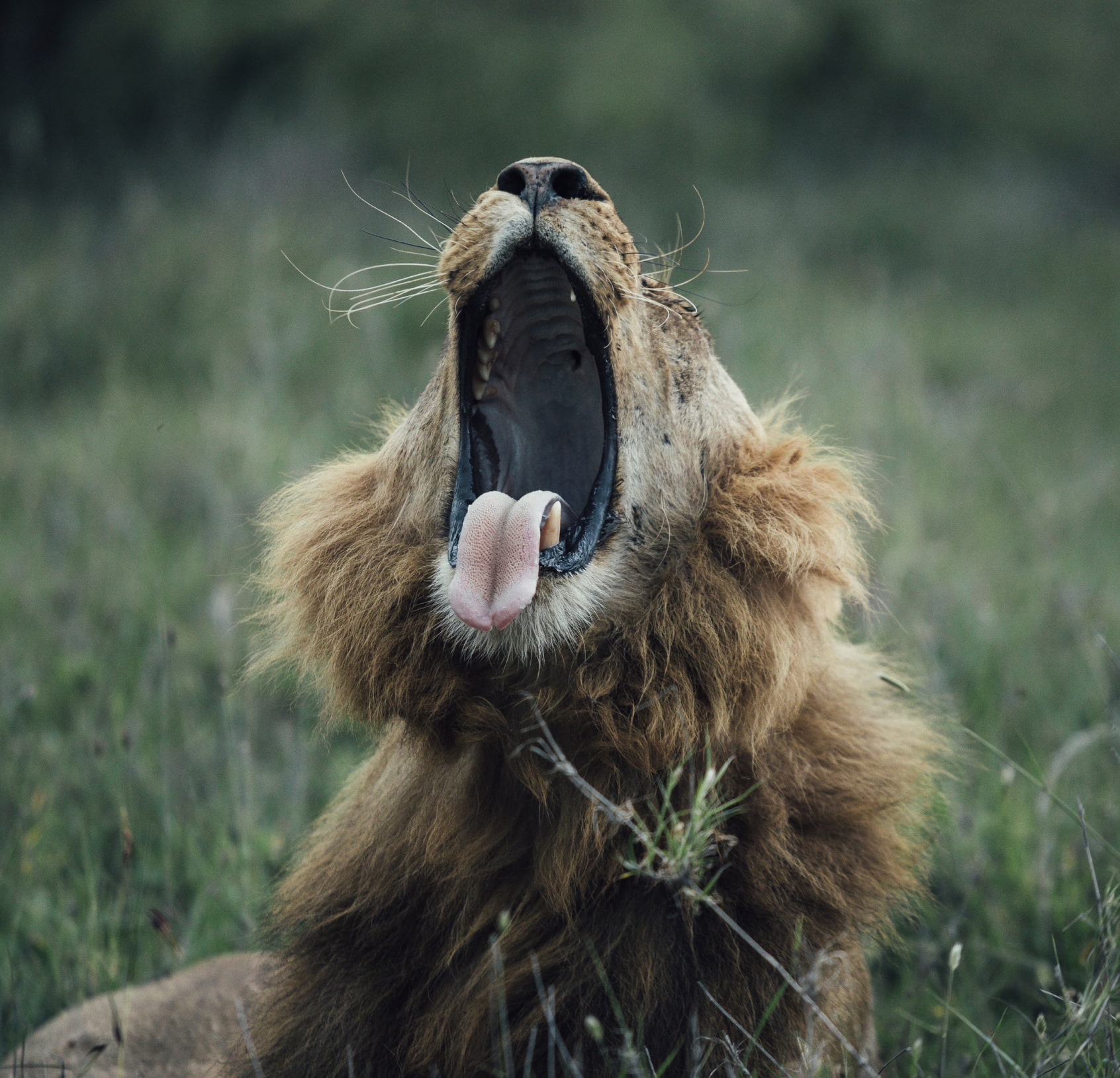
We have always had lions in Nairobi National Park, and over the years we’ve come to know several of the prides rather well.
One lion in particular will always stand out. Kitili.
Kitili was a magnificent male lion with one eye, and for years he was one of the park’s great characters. We knew him from when he was a cub, watched him grow into an unruly teenager and eventually become a rather impressive adult.
It was a bit like watching our own children grow up, although I am pleased to report that William, Netty and Alex have so far managed to settle most of their disagreements without resorting to the sort of behaviour that is perfectly acceptable in lion society. Kitili eventually lost his position to younger males. Sadly, he also lost his life. It was heartbreaking. We had watched this animal grow up, knew his territory, his habits and his history. To us he wasn’t simply another lion. He was Kitili.
But that’s the reality of the bush. Nature doesn’t always deliver the happy ending we’d like, and the animals certainly don’t consult us before making life-changing decisions. The lovely thing is that there are always new generations coming through. New cubs, new prides, new characters to get to know.
For visitors hoping to see lions in Nairobi National Park, the early mornings are usually particularly rewarding. Lions are often more active when it’s cool, before retiring to the shade to sleep for most of the day. Which, when you think about it, isn’t a bad lifestyle.
Our guides know the park and its lion territories incredibly well, although I should point out that lions are notoriously unreliable when it comes to keeping appointments. You can spend an entire morning searching for them, only to discover they’ve been lying behind a bush beside the road you drove down an hour earlier.
It’s all part of the fun.
Rhinos – Rather More Personal Than You Might Imagine
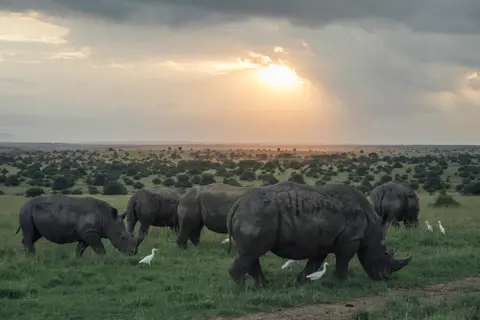
Nairobi National Park is one of Kenya’s important rhino sanctuaries, and we are incredibly fortunate to have both black and white rhinos here. For those who don’t know the difference, white rhinos tend to graze on grass, while black rhinos browse on bushes and shrubs. Both are grey, which has always struck me as a rather unfortunate piece of naming.
Black rhinos can be quite elusive, particularly when they’re tucked away in thick vegetation, but Nairobi is one of the better places in Kenya to see them. We had a wonderful old black rhino who lived around The Emakoko for years. He was a familiar sight in the valley, occasionally wandering below the guest rooms, completely oblivious to the excitement he caused. Imagine coming all the way to Africa, settling into your room with a cup of tea and looking down to find a wild black rhino wandering about beneath your balcony.
Not a bad start to a holiday.
He lived to the grand old age of 33, which is quite something for a wild rhino, but eventually became involved in a territorial dispute with a younger male. I remember being woken in the early hours of the morning by the most dreadful noises coming from the bush. We contacted the rhino unit, and everyone did what they could, but sadly he didn’t survive.
I was devastated.
I know that sounds rather sentimental, but when you live alongside these animals for years, you become terribly attached to them. They have personalities, habits and favourite places. You recognise them, and you notice when they’re missing. And sometimes, just occasionally, they provide some much-needed comic relief.
During the terrible drought, when we were desperately trying to keep the wildlife alive by distributing hay around the park, I came across a white rhino sitting in the middle of a great big pile of it. He had clearly decided that rather than waste energy walking around looking for food, he would simply sit in the food and eat his way out. When I came back from the school run, he was still there. He’d merely turned around to tackle the other side. I thought it was an excellent system.
The Leopard Who Became Part of the Family
Leopards are one of the most difficult animals to see in Nairobi National Park – and infact anywhere. They’re secretive, mostly solitary, and extremely good at disappearing into the bush.
But we’ve been extraordinarily lucky.
For years we’ve known a leopardess called Koko, who grew up around The Emakoko. We’ve watched her develop from a youngster into an adult and eventually become a mother herself and moving into her own territory. There is something rather special about knowing an individual wild animal for that long. You become familiar with her movements, her favourite places, and the areas she likes to disappear into. And then, just when you think you know where she might be, she proves you completely wrong.
Typical cat.
Koko has provided us with some extraordinary sightings over the years, and she remains one of the animals I am most fond of. Of course, being fond of a leopard is rather different from being fond of a Labrador. One is considerably less interested in having its tummy rubbed, and I have absolutely no intention of testing the theory. We wrote about one of our more memorable leopard experiences in Leopard in My Lap, which gives you some idea of the unexpected situations one can find oneself in when living on the edge of a national park.
There are Cheetahs in Nairobi National Park too, although sightings are much rarer. The park is also home to spotted hyenas, black-backed jackals, servals and the very elusive caracal. You may not see all of them on a single game drive, or indeed on several game drives, but that’s what makes it so exciting when you do.
A leopard sighting is always special precisely because you can’t order one in advance.
Melman – The Giraffe Who Didn’t Quite Understand He Was a Giraffe
Of all the animals we’ve encountered over the years, I think Melman deserves a special mention. During the dreadful drought, we lost an enormous number of animals. There simply wasn’t enough grazing, and with wildlife movement increasingly restricted by development around the park, the situation became desperate. Among the casualties was a female giraffe who left behind a young calf. Melman.
Somehow, this rather gangly young giraffe ended up becoming part of our lives. Now, anyone who has ever spent time around giraffes will know that they’re extraordinary creatures. Elegant from a distance, slightly ridiculous up close, and blessed with a remarkable ability to put their heads exactly where you least expect them.
Melman became very much part of the household. The children adored him, and he seemed quite happy with the arrangement. He even had our three Belgian Malinois dogs keeping a watchful eye on him, which must have been one of the more unusual giraffe security arrangements in Kenya. But of course, the whole point was that Melman needed to grow up and become a proper wild giraffe. And so began the rather nerve-racking process of encouraging him to venture further away from home.
He would disappear into the bush during the day and then come back in the evening, rather like a teenager testing the boundaries of independence. Except that most teenagers don’t have lions waiting for them around the corner. I worried about him constantly. Every time he disappeared, I wondered whether he would return. And every time he came back, I felt enormously relieved, while also knowing that eventually the best thing for him would be not to come back at all.
That’s the difficult thing about helping wild animals. You become attached to them, but the happiest outcome is often the one in which they no longer need you. I suspect there’s a parenting lesson in there somewhere.
Buffalo – The Neighbours Nobody Asked For
If giraffes are elegant and rhinos are magnificent, buffalo are, well, buffalo. They are extraordinary animals, enormously powerful, rather unpredictable and not particularly interested in what anyone else thinks. We have plenty of them in Nairobi National Park, and they are among the animals you’re most likely to see on a game drive.
But during the drought, we became considerably better acquainted with them than we’d ever intended. As the grazing disappeared, the buffalo began gathering around the lodge, searching for food and water. At first there were only a few. Then twelve. Then thirty-six.
And before we knew it, we appeared to be running some sort of buffalo retirement home.
Anton and I, together with our wonderful team and Kenya Wildlife Service, began distributing supplementary food to help them survive. It was exhausting, expensive and, at times, completely overwhelming.
Buffalo have enormous appetites and very little understanding of budgets. And once they’ve decided your property is a suitable place to congregate, they’re not particularly interested in moving on. We’ve had all sorts of encounters with them over the years, including one memorable incident involving a buffalo and our swimming pool.
You can read that particular adventure in Buff in the Pool.
Let’s just say that buffalo and swimming pools are not an ideal combination.
The Drought – When Everything Changed
Living in the bush is an extraordinary privilege, but it also means witnessing things that most people never see. The drought was one of the hardest periods we’ve ever experienced at The Emakoko. The grass disappeared. The rivers dwindled. Animals that should have been able to move across the landscape in search of grazing found themselves increasingly restricted.
And slowly, terribly, they began to die. It was heartbreaking.
We started buying hay and molasses to feed the animals, working with Kenya Wildlife Service and doing whatever we could to keep them going. But the numbers were overwhelming, and we simply couldn’t afford to continue on our own. In desperation, I contacted my mother and asked whether she might persuade a few of her bridge and golf friends to contribute towards a lorry-load of hay.
I thought we might raise enough for a delivery or two. Within 24 hours she’d raised over $5,000.
By the end of the week, it was over $10,000. More than 250 people contributed.
I was completely overwhelmed. People who had never visited Nairobi National Park, and in some cases had never even been to Kenya, were helping us feed buffalo, zebras, giraffes and rhinos. It was one of those moments that restores your faith in humanity.
We couldn’t save everything. We lost animals that we’d known for years, and there are some memories from that time that will never leave me. But we did save others. And then, eventually, the rains came. Almost overnight, the landscape began to change. The brown, dusty plains turned green. Flowers appeared. The animals began to recover. It was extraordinary.
I don’t think I’ve ever appreciated a blade of grass quite so much in my life. And it made me realise, more than ever, just how fragile this little national park really is.
So, When Is the Best Time to Visit Nairobi National Park?
This is another question we get asked all the time. And the truth is, there really isn’t a bad time.Nairobi National Park changes enormously throughout the year, and each season has something special to offer.
From June through October, the weather is generally drier and the grass shorter, which makes animals easier to spot. This is often considered the best time for wildlife viewing, particularly for visitors hoping to see lions and rhinos. The main rains usually arrive around March, April and May, with shorter rains often falling in November and December. Although these days, the weather seems to have developed a mind of its own.
During the wetter months, the park becomes wonderfully green, the skies are dramatic and the birdlife is extraordinary. It’s also a beautiful time for photography. Personally, I love the park when it’s green. Everything looks fresh and alive, and the contrast between the grass, the wildlife and the enormous African skies is spectacular. But if you’re visiting for the first time and particularly keen to see predators, the drier months can make life a little easier.
As for the best time of day, early morning is usually wonderful. The lions are often more active, the light is beautiful and the temperatures are comfortable.
Late afternoon can be equally rewarding. And if you’re staying with us at The Emakoko, there’s the added advantage that you don’t have to spend half your morning driving out from Nairobi before you’ve even started your safari. You can wake up in the bush, have a cup of tea and head straight out with one of our guides.
Much more civilised.
Do You Really Need More Than Half a Day?
Nairobi National Park is often treated as somewhere to visit for a few hours before catching a flight or heading off on safari elsewhere in Kenya. And while a half-day game drive can be absolutely wonderful, I do think the park deserves rather more attention than it usually gets.
You can easily see giraffes, zebras, buffalo, warthogs and a wonderful variety of antelope in a few hours. With a bit of luck, you might find lions or rhinos too. But wildlife doesn’t work to a timetable. Some of our most memorable sightings have happened when we weren’t looking for anything in particular. A leopard appearing unexpectedly on a quiet track. A lion pride emerging from the grass. A rhino wandering through the valley below the lodge.
Or simply sitting on the terrace, watching the world go by, when something rather extraordinary decides to make an appearance.
The longer you spend here, the more you begin to appreciate the smaller things as well. The birds, the changing light, the sounds of the bush at night. And the fact that all of this exists just outside Nairobi. It’s rather extraordinary when you stop to think about it.
Why This Little Park Matters So Much
Nairobi National Park was established in 1946, making it Kenya’s first national park. At the time, wildlife could move freely across vast areas of land surrounding Nairobi. Today, the city has grown enormously, and the park is under increasing pressure from development.
The southern wildlife corridors are particularly important, allowing animals to move between the park and the wider Athi-Kapiti ecosystem. Without these connections, the future of the park’s wildlife becomes considerably more uncertain. And having lived here for so many years, that’s something that worries us enormously.
The park isn’t simply a tourist attraction. It’s home to an extraordinary collection of animals, many of which are increasingly threatened elsewhere. It’s an important sanctuary for black rhinos, a refuge for lions and other predators, and a place where future generations can still experience wild Africa within sight of a capital city.
I often think about how lucky our children have been to grow up here. They’ve seen things that most people only ever watch on television. They’ve learned that wildlife can be beautiful, funny, unpredictable and sometimes terribly sad. And, perhaps most importantly, they’ve grown up understanding that these animals need protecting.
I hope that’s something they’ll carry with them for the rest of their lives.
Life on the Edge
People sometimes ask whether we ever get tired of living in the bush. The answer is no. Frustrated, certainly. Exhausted, frequently. Occasionally driven completely mad by an animal that has decided to do something spectacularly inconvenient.
But bored? Never.
Anton and I have been incredibly fortunate to build our lives here, raise our family and share this extraordinary place with people from all over the world. The Emakoko has never felt like just a lodge to us. It’s our home. And the animals are part of it.
We’ve watched lion cubs grow into magnificent adults, known rhinos for decades, helped an orphaned giraffe find his feet, and spent far too much time worrying about buffalo. We’ve laughed, cried, celebrated and occasionally wondered whether we were completely mad. And through it all, Nairobi National Park has continued to surprise us.
So, if you’re wondering whether Nairobi National Park is worth visiting, whether you might see lions or rhinos, or whether a safari so close to a city can really feel wild, I can assure you that it can.
Come and spend a little time with us at The Emakoko.
We can’t promise which animals you’ll see. But I can promise that the bush will have something interesting up its sleeve.
It always does.
Emma


